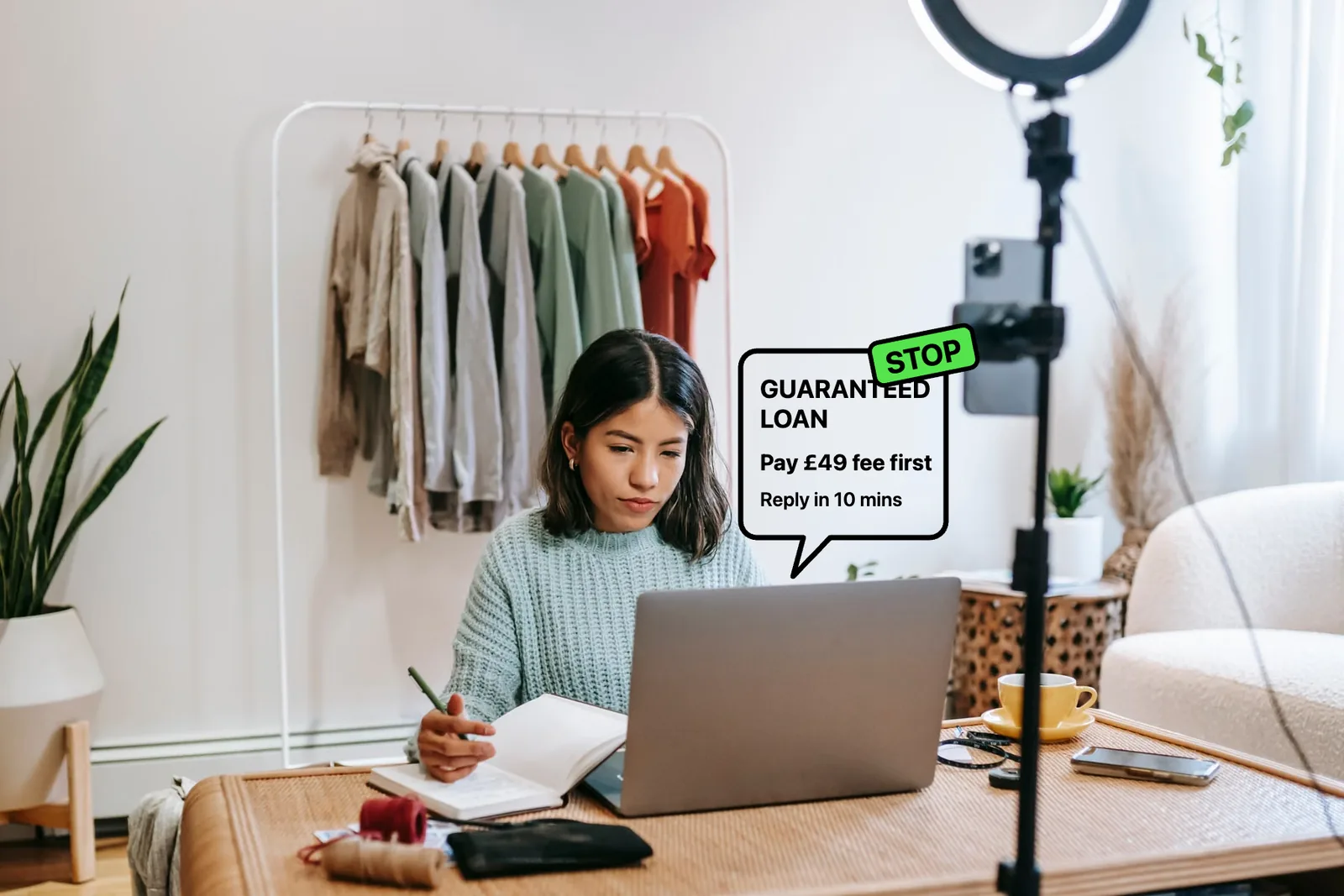
Loan scammers often target people who need money quickly or have found it difficult to get credit elsewhere. They may promise easy approval, ask for a fee and then disappear without providing a loan.
Some scams use professional websites, realistic documents and the details of genuine financial firms. A polished website or an FCA reference number is not enough on its own.
Stop and check the offer before sending money or personal information.
Check a loan offer for warning signs
Answer yes or no to each question. The checker highlights warning signs. It cannot verify a company, and nothing you select is saved or sent.
- 01Did the company contact you unexpectedly?
- 02Did it guarantee approval before completing checks?
- 03Has it asked for money before releasing the loan?
- 04Does it want payment by cryptocurrency, gift card, cash transfer or another unusual method?
- 05Is it pressuring you to pay immediately?
- 06Do its contact details differ from the FCA Firm Checker?
Your result appears once all six questions are answered.
The clearest warning signs
One warning sign does not always prove that an offer is fraudulent. Several warning signs together should give you a strong reason to stop.
You were contacted unexpectedly
Be cautious if a company offers you a loan through an unexpected telephone call, email, text message, WhatsApp message or social media account.
Ask yourself how the company obtained your details. Do not click a link in the message to check who it is.
Approval is guaranteed
A regulated lender should assess whether credit is suitable to provide based on the information available. A promise that everyone is accepted, with no questions or checks, should be treated with caution.
A broker may say that it works with lenders that consider different credit histories. That is not the same as guaranteeing approval.
You must pay before receiving the loan
Loan fee fraud normally involves a criminal asking for an upfront payment for credit that is never provided.
The payment may be described as:
- An administration fee
- An insurance payment
- A release fee
- A security deposit
- Tax
- A transfer charge
- A fee to improve your credit score
After the first payment, the scammer may invent another problem and request more money.
Some legitimate credit brokers charge fees. However, the fee, the identity of the business and when payment is due should be explained clearly. Do not pay a fee that was unexpected or not properly disclosed.
The payment method is unusual
Be especially cautious if you are asked to pay using:
- Cryptocurrency
- Gift cards or voucher codes
- A cash transfer service
- Money sent to a personal bank account
- A payment to a different company or person
- Several small payments to unlock the loan
Do not accept the explanation that an unusual payment is required because of your credit history.
You are being rushed
A scammer may claim that the loan offer will disappear within minutes. It may repeatedly call, tell you not to speak to your bank or pressure you to pay while still on the telephone.
A genuine company should allow you time to read the terms and check its identity.
It asks for access to your phone or computer
Do not install an application or remote access program because somebody offering a loan tells you to.
Never allow a caller to view your online banking. Never reveal:
- Your banking password
- Your card PIN
- A one time security code
- A full security answer
- A password reset code
A criminal may claim that this is required to verify your account or transfer the loan. It is not a safe way to verify a borrower.
Check the firm properly
Use the FCA Firm Checker before dealing with a lender or credit broker.
Check:
- 01The firm’s exact name
- 02Whether it is authorised
- 03Whether it has permission for the relevant service
- 04Its website address
- 05Its email address
- 06Its telephone number
Use the contact details shown by the FCA to contact the firm. Do not use the number, link or email address supplied in an unexpected message.
Watch for clone firms
A clone firm copies information from a real authorised business. It may use the genuine firm’s:
- Name
- Address
- Logo
- Firm Reference Number
- Staff names
- Website wording
The scammer then changes the telephone number, website or email address.
Finding the correct company name on the FCA system does not prove that the person contacting you works for that company. The contact details must also match.
If they do not match, contact the genuine firm using the details from the FCA Firm Checker.
You can also search the FCA Warning List. A firm not appearing on the list is not automatically safe because new scams may not have been reported yet.
Other signs that deserve a closer look
Stop and check if:
- The website address is a misspelt version of a known brand
- The sender uses a free email account instead of the firm’s domain
- The company will not provide written terms
- The loan amount or repayment changes without explanation
- You are told to lie on an application
- The sender asks you to move money through your account
- The firm refuses to explain whether it is a lender or broker
- The bank account receiving the fee is in an unrelated name
Do not rely only on spelling and design. Fraudsters can copy real websites and create convincing documents.
What to do before accepting an offer
Take five minutes to complete these checks:
- 01Open the FCA Firm Checker yourself.
- 02Check the firm’s permissions and contact details.
- 03Call the number shown by the FCA.
- 04Read the loan terms and total amount repayable.
- 05Check whether any fee was disclosed before you applied.
- 06Confirm whether you are dealing with a lender or broker.
- 07Ask someone you trust to look at the offer if you still feel unsure.
Do not continue simply because you have already spent time on the application.
What to do if you have already paid
Act as soon as possible.
Contact your bank
Contact your bank or payment provider immediately using the telephone number on your card, banking application or official website.
Explain that you believe you paid a scammer. Ask whether the payment can be stopped, recalled or investigated.
Recovery is not guaranteed, but acting quickly may improve the available options.
Stop communicating with the scammer
Do not send another payment, even if the scammer claims it will release your loan or refund the first fee.
Block the relevant numbers and accounts after saving the evidence.
Save the evidence
Keep copies of:
- Messages and emails
- Telephone numbers
- Website addresses
- Payment details
- Receipts
- Names used by the scammer
- Screenshots of the offer
- Any loan documents received
Do not delete messages until you have reported what happened.
Secure your accounts
If you disclosed a password, change it immediately. Change the password on any other account where you used the same one.
Turn on two step verification where it is available.
If you installed remote access software, disconnect the device from the internet, remove the software and follow current NCSC recovery guidance.
Report the fraud
If you live in England, Wales or Northern Ireland, report it through Report Fraud.
If you live in Scotland, contact Police Scotland on 101.
Call 999 if a crime is happening now and somebody is in immediate danger.
You can also report the scam to the FCA.
Beware of recovery scams
Someone who has already lost money may be contacted again by a person claiming to be:
- A recovery agent
- A solicitor
- A regulator
- A police officer
- A bank investigator
They may promise to recover the lost payment after another fee is paid.
Do not pay. Contact the organisation independently using its official published details. A genuine regulator or police service will not require a payment to release recovered loan funds.
If somebody claims to represent LoansForBadCreditUK.co.uk
LoansForBadCreditUK.co.uk is a credit broker, not a lender.
Only use contact details published on our website. If somebody claims to represent us and asks for an unexpected payment, stop and contact us directly through the official website.
An introduction to a lender does not mean that a loan has been approved. The lender is responsible for its own decision and will provide the credit agreement if an application is accepted.
Frequently asked questions
No. Some legitimate brokers may charge a properly disclosed fee. However, an unexpected fee, pressure to pay or repeated demands before receiving a loan are serious warning signs. Verify the business independently before paying.
No. Scammers can copy a real firm’s reference number. Check that the telephone number, email address and website match the FCA Firm Checker.
A promise of guaranteed approval before proper checks should be treated with caution. A broker can search for possible options, but it cannot guarantee that a lender will approve an application.
Recovery is not guaranteed. Contact your bank or payment provider immediately and explain what happened. Do not pay anyone who promises recovery in return for another fee.
Stop contact, change any affected passwords and monitor your bank and credit files. Contact your bank immediately if you shared banking or card information.
Important information
LoansForBadCreditUK.co.uk is a credit broker, not a lender. We cannot guarantee approval or a particular interest rate.
This guide provides general fraud prevention information. Scam methods change, so check current information from the FCA, NCSC, Report Fraud and Police Scotland.